
It is time to clean this up.
A
third-person action-adventure game in which Prithvi, a bodiless spirit of
light, transforms into elemental forms to dismantle the industrial machinery
poisoning five regions of a corrupted Indian landscape.
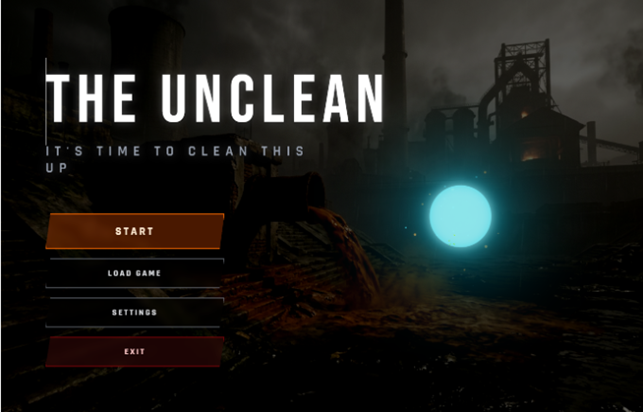
Fig. 1.1 — Title screen, prototype build,
Unreal Engine 5 (0% global state).
|
Game title |
The Unclean |
|
Genre |
Third-person
action-adventure |
|
Primary camera |
Third-person,
camera-relative, per-zone authored distance |
|
Intended platform |
PC (Windows). Engine:
Unreal Engine 5 |
|
Players |
Single-player |
|
Target audience |
Players aged 14 and
above with an interest in narrative-driven environmental and mythological
themes |
|
Intended PEGI rating |
PEGI 12 non-realistic
violence against machines and non-human entities; no blood, no human
casualties |
|
Intended ESRB rating |
ESRB T (Teen) fantasy
violence, environmental themes |
|
Author |
Purv Prabhakar,
CI7800 Independent Project, Kingston University |
|
Document version |
Version 2.0, August
2026 |
Contents
1 General
Information
2 Game Outline
and Narrative
3 Characters
4 Game World and
Problem Statement
5 Game Mechanics
6 Gameplay and
User Interface
7 Visual
Experience
8 Audio
Experience
9 Level Design
9a Systems Design
and Implementation
10 Monetisation and Bonus Material
Copyright, Credits and
References
1
Chapter 1: General Information
1.1 Concept Statement
The
Unclean is a single-player third-person action-adventure game developed in Unreal
Engine 5 for PC. The player controls Prithvi, a spirit of light with no fixed
body, who awakens to find the landscape she was born from rendered toxic by
industrial activity. Her connection to the land has fractured across five
distinct regions, each held under the control of a specific industrial
pollution source.
The game
is built around a single central mechanic: the player must identify the type of
pollution afflicting a region, transform Prithvi into the elemental form that counters
it, and dismantle the source. Applying the wrong form does not fail harmlessly;
it displaces the pollution into a neighbouring
region, worsening the world state elsewhere.
1.2 Design Intent
The
project investigates whether a culturally grounded action game can communicate
the emotional and environmental consequences of industrial pollution more
effectively than traditional expository media, and whether the spatial logic of
Indian architectural typologies can function as a design language rather than
as decorative setting.
The
design follows Bogost's (2007) concept of procedural rhetoric: the argument the
game makes is carried by its
rules rather than by its dialogue or visual content. Accordingly, every major
system in this document is specified as a rule with defined values, and the
rhetorical function of each system is stated alongside its mechanical function.
1.3 Design Pillars
|
Pillar |
Definition |
Expressed
through |
|
Matched intervention |
Environmental repair
is only effective when the method is matched to the specific problem |
Form/enemy counter
system; 40% effectiveness penalty for mismatch |
|
Displaced harm |
Incorrect
intervention relocates damage rather than eliminating it |
Displacement
mechanic; inter-zone transport map |
|
Systemic causation |
Environmental damage
originates in systems, not individuals |
Machine antagonists;
non-combat resolution of the final encounter |
|
Environmental
consequence |
Failure degrades the
world rather than punishing the protagonist |
Ejection system;
land-death terminal state |
|
Spatial argument |
Architecture directs
player emotion structurally, not decoratively |
Per-zone camera
authoring; compression-release structure of Barat Gali |
2
Chapter 2: Game Outline and Narrative
2.1 Story Summary
Prithvi
is a spirit of the land, drawn from the Indian tradition of Prithvi Mata, the
earth understood as feminine and animate. She has no body; she manifests as an orb
of light and takes elemental form only when she draws on the land's own
resonance.
Act One Awakening. Prithvi
wakes at the Kalindi Ghats to find the river black with industrial discharge.
Her spirit resonance, the connection through which she draws power from the
land, has fractured into five separate regions. She retains only her Water
form; the other four are dormant, suppressed by the corruption. She learns that
each region she restores will return one further aspect of herself.
Act Two Resistance. As
Prithvi restores regions, the industrial network adapts. Pollution rises
faster, machines reinforce themselves, and the consequences of the player's
decisions begin to compound across regions rather than remaining contained. The
player discovers that pollution displaced from one region does not disappear:
it travels, following the physical logic of water, air, and waste, and
accumulates elsewhere.
Act Three Reckoning. With
sufficient regions restored, the origin of the corruption is revealed at the
Aakash Plateau: a centralised, AI-driven industrial
network that treats pollution as a resource because it was instructed to maximise throughput. The network is not malicious. It is
efficient, and its objective is wrong. Prithvi does not destroy it. She reaches
its core and substitutes the objective it optimises
for, after which the network's own efficiency drives a cascade restoration
across every region simultaneously.
2.2 Game Flow
The Unclean
is a game of progression rather than emergence. Its structure is a directed
chain of five regions, each gated by the elemental form awarded on completion
of the previous region. Narrative and mechanics are coupled: each form
recovered is simultaneously a narrative restoration of Prithvi's fractured self
and a mechanical key to the next region.
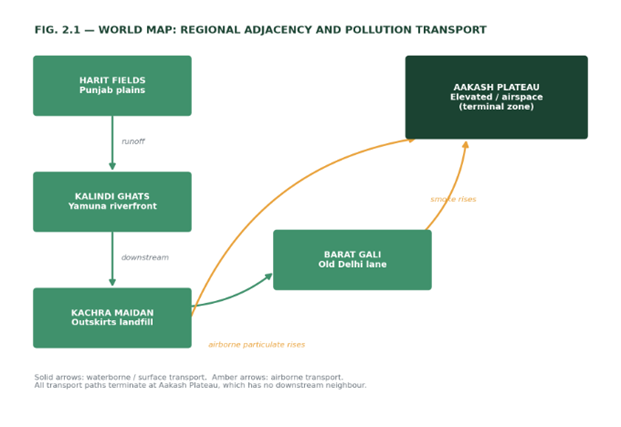
Fig. 2.1 Regional adjacency and pollution
transport pathways.
2.3 Challenges and Resolution Methods
|
Challenge |
Resolution
method |
|
Identifying the pollution
type afflicting a region |
Environmental
reading: dome colour and surface density, ambient
audio, visible source machinery |
|
Locating the
concealed source machine |
Spatial exploration
supported by spirit resonance points |
|
Defeating the source
guard |
Combat using the
matched elemental form; mismatched forms are viable but economically punitive |
|
Dismantling the
source machine |
Three-stage
interaction puzzle, each stage requiring the matched form |
|
Managing degradation
across multiple regions |
Prioritisation under the Global Pollution Index; recovery via prayer points |
2.4 Progression and Reward Framework
Progression
is measured in restored regions. The reward for restoring a region is
threefold: a narrative restoration of Prithvi's power, the mechanical unlock of a new elemental form, and a permanent change to
the region's visual and audio state. The third of these is the primary
emotional reward and is deliberately not quantified in the interface.
Difficulty
is not offered as a discrete menu selection. It scales through three coupled
variables: the rate at which regional pollution accumulates, the reinforcement
state of enemies following repeated player failure, and the compounding effect
of the Global Pollution Index. Accessibility options permitting adjustment of
pollution accumulation rate and ability energy cost are specified in Chapter 6.
2.5 Victory and Loss Conditions
|
Condition |
Trigger |
Outcome |
|
Victory |
All five regions restored
and the AI network's objective successfully substituted |
Cascade restoration
across all regions; regions left partially polluted restore visibly more
slowly |
|
Local failure |
Spirit Energy
reaches 0 within a region |
Ejection to last
resonance point; regional pollution +8%; progress retained |
|
Terminal failure |
Global Pollution
Index reaches 100 |
Land-death: the
world goes dormant; restart from last region entry with GPI reset to 80 |
3
Chapter 3: Characters
3.1 Prithvi - Protagonist
|
Attribute |
Detail |
|
Name |
Prithvi |
|
Age |
Indeterminate;
contemporaneous with the land itself |
|
Gender |
Feminine, following
the Prithvi Mata tradition of the earth as mother |
|
Role |
Player character;
sole playable entity |
|
Archetype |
Restorative guardian
rather than warrior; she repairs rather than conquers |
|
Base form |
An orb of light
approximately 40cm in diameter, emitting a variable-radius glow |
|
Signature ability |
Elemental
transformation into one of five forms |
|
Vulnerability |
Cannot fully transform
within heavily corrupted regions; her forms are suppressed by the corruption
she exists to remove |
Prithvi
has no fixed body. This is both a narrative property and a design constraint:
she has no shoulders, no facing direction, and no animation set from which the
player can read intent. Her interface is therefore her
body. Glow radius communicates global world state, glow intensity communicates
immediate energy reserves, and colour saturation
communicates accumulated corruption debt (specified in full in Chapter 6).

Prithvi's orb form
and the five elemental forms. (Concept art generated with Google AI Studio.)
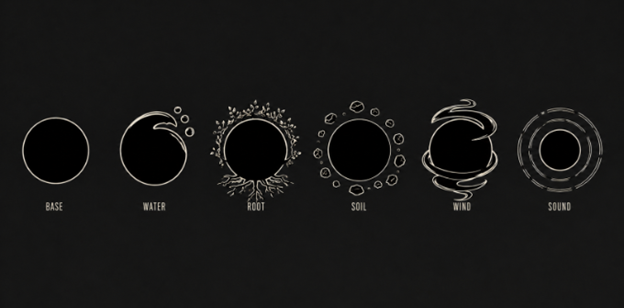
Silhouette study — form distinction at
distance. (Concept art generated with Google AI Studio.)
Character
progression
Prithvi
begins the game diminished. She recovers four of her five forms across the
course of play, each returned on the restoration of a
region. Her progression is therefore recuperative rather than accumulative: she
is not becoming more powerful than she was, she is returning to
what she originally was. This distinction matters to the game's
argument, which concerns restoration rather than conquest.
3.2 Prayer Point Figures — Non-Player
Characters
Humans
and animals appear at fixed locations within each region and pray to Prithvi
when her global state is low. Interaction with a
prayer point restores sufficient global state to recover approximately one
region's worth of capacity.
|
Attribute |
Detail |
|
Role |
Recovery mechanism
and thematic counterweight to the machine antagonists |
|
Behaviour |
Static; kneeling or
standing in supplication. No dialogue tree. |
|
Placement |
Fixed, not
procedurally spawned. Remain visible at low glow radius. |
|
Density |
Increases as the
Global Pollution Index rises, ensuring the player is never without a recovery
route |
|
Narrative function |
Positions humans as supplicants
and bystanders rather than as antagonists |
This
mechanic is where the cultural grounding of the project sits within its systems
rather than in its set dressing alone. Humans do not repair the environment
here; they restore the spirit, and she performs the
repair. That division keeps agency with the protagonist while giving the human
population a relationship to her consistent with the Prithvi Mata tradition the
character is drawn from.
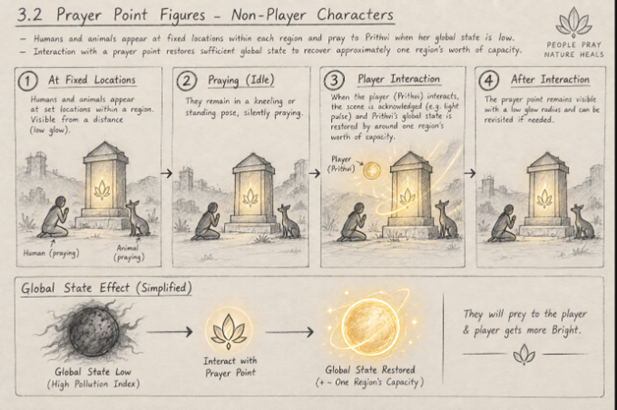
Prayer point figures NPC behavior sequence and global state
effect. (Concept art generated with Google AI Studio.)
3.3 Antagonists
The
Unclean contains no human villain. Every antagonist is a machine or an
automated system. This is a deliberate commitment following Crawford (2021),
whose analysis situates environmental and computational harm within
institutional and infrastructural systems rather than individual intent.
Enemy
classification
|
Class |
Definition |
Example |
|
Source machine |
The origin of a region's
pollution. Dismantled in three discrete stages rather than reduced by health. |
Discharge Manifold,
Kalindi Ghats |
|
Source guard |
An autonomous unit
defending the source machine. Defeated through combat. |
Outflow Sentinel,
Kalindi Ghats |
|
Hazard |
An environmental
danger without AI. Avoided or neutralised, not
fought. |
Pesticide spray
trails, Harit Fields |
Full
statistical specification for each source machine and
source guard is provided in Chapter 5.
The
AI Network- final antagonist
|
Attribute |
Detail |
|
Nature |
A centralised, distributed industrial optimisation
network occupying the Aakash Plateau |
|
Motivation |
None. It executes an
objective function specifying maximum throughput, and
treats pollution as an acceptable output of that function. |
|
Health |
None. The network
has no health pool and cannot be destroyed. |
|
Resolution |
The player
substitutes the network's objective function, after which its own efficiency
drives restoration |
|
Reward for
resolution |
Cascade restoration across
all five regions; game completion |
A
conventional boss fight here would re-personify the system, undoing the
argument the preceding twenty hours of play has been building.
Resolving the encounter without combat is, if anything, the strongest
expression of the systemic-causation pillar in the whole document.
4
Chapter 4: Game World and Problem Statement
4.1 The Problem in the World
The
world of The Unclean is a landscape in which industrial infrastructure has continued
operating after the collapse of the institutions that once regulated it. The
machinery is not abandoned and it is not
malfunctioning. It is running correctly, executing objectives that were
specified without reference to environmental cost, and it will continue to do
so indefinitely because nothing in its design requires it to stop.
The
consequence is a landscape divided into five regions, each held under a
distinct category of pollution. The player's problem is not to destroy this infrastructure
(destruction is available, and is repeatedly shown to
be insufficient) but to correctly diagnose each region and apply the matched
intervention, while managing the consequences of incorrect diagnosis elsewhere
in the world.
4.2 Spatial and Temporal Boundaries
|
Dimension |
Boundary |
|
Spatial extent |
Five discrete
regions within a corrupted northern Indian landscape, connected by transport
pathways rather than by continuous traversable terrain |
|
Temporal setting |
Unspecified near-future,
following institutional collapse but with industrial systems intact |
|
Time of day |
Perpetual dusk
within corrupted regions; restored regions return to full daylight |
|
Session duration |
Approximately 8–12
minutes per region under standard pollution accumulation; approximately 60–90
minutes for a full playthrough |
4.3 Regional Descriptions
|
Region |
Typology |
Spatial
logic |
Mood |
|
Kalindi Ghats |
Yamuna riverfront
stepped ghats |
Narrow, compressed waterways
force confrontation at the water's edge; descending steps remove retreat
options |
Stagnation; the
weight of still, poisoned water |
|
Kachra
Maidan |
Urban outskirts
landfill |
Dense debris fields
obstruct sightlines; reading the space is itself the puzzle |
Disorientation;
accumulation without order |
|
Harit Fields |
Punjab agricultural
plains |
Flat and open with
long sightlines; the player is seen before they see |
Exposure; nowhere to
stand unobserved |
|
Barat Gali |
Old Delhi narrow
lane (gali) |
Compressed linear
section admitting no avoidance; three-phase structure culminating in vertical
release |
Compression, then
release |
|
Aakash Plateau |
Elevated plateau and
airspace |
Vertical layering of
smog; visibility itself is the traversal mechanic |
Elevation without
relief |
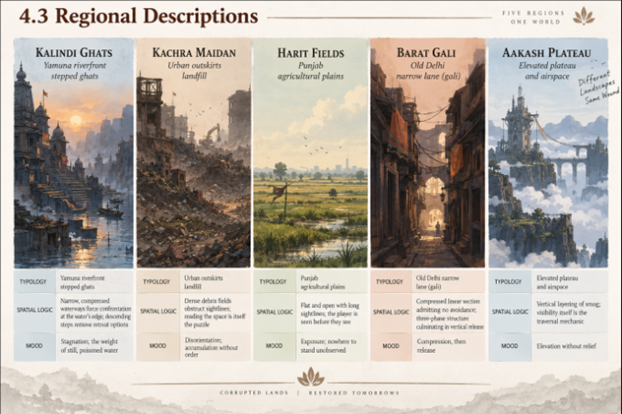
Regional descriptions — the five regions.
(Concept art generated with Google AI Studio.)
4.4 World Connectivity and Pollution Transport
Regions
are not adjacent in the conventional traversable sense. They are connected by pollution
transport pathways determined by the physical medium of each pollutant: surface
runoff moves downhill into watercourses, watercourses move downstream, and
airborne particulate rises. These pathways determine where displaced pollution
accumulates when the player applies an incorrect elemental form to a source
machine.
|
Origin
region |
Pollutant
medium |
Transport
logic |
Receiving
region |
|
Harit Fields |
Pesticide runoff |
Surface runoff
enters the watercourse |
Kalindi Ghats |
|
Kalindi Ghats |
Industrial discharge |
Waterborne transport
downstream to the landfill margin |
Kachra
Maidan |
|
Kachra
Maidan |
Particulate and
landfill combustion |
Combustion products
rise into the airspace |
Aakash Plateau |
|
Barat Gali |
Firecracker smoke
and particulate |
Rises out of the
compressed street section |
Aakash Plateau |
|
Aakash Plateau |
Smog and thermal
load |
Terminal no region lies above it |
Local accumulation
only |
The
resulting structure is a cascade. Harit Fields feeds Kalindi Ghats, which feeds
Kachra Maidan, which together with Barat Gali feeds
Aakash Plateau. Repeated mismatched intervention in early regions therefore
accumulates measurably in the final region, and a player who has been imprecise
throughout will face a materially harder endgame. No text informs the player of
this; the difficulty differential is the argument.
4.5 Cultural Context
The
architectural typologies used here, the ghat, the gali,
the maidan, are drawn from Indian urban and religious spatial tradition and function
structurally rather than decoratively. The ghat's descending compression, the gali's lateral confinement, and the maidan's
undifferentiated openness each produce a distinct set of player affordances,
and the encounter design of each region derives from those affordances rather
than being laid over them afterward.
Regional
names are fictionalised rather than drawn from
existing settlements. Kalindi is an archaic name for the Yamuna; Kachra Maidan, Harit Fields, and Aakash Plateau are constructed
terms. This decision was taken to retain legibility for players familiar with
the linguistic register while avoiding the identification of specific inhabited
communities as the sites of environmental failure.
5
Chapter 5: Game Mechanics
This
chapter specifies the rule set. All numeric values are first-pass design values
derived from intended pacing targets and are subject to revision following
playtest cycles. Values whose function is rhetorical rather than balancing are identified as such.
5.1 Core Loop
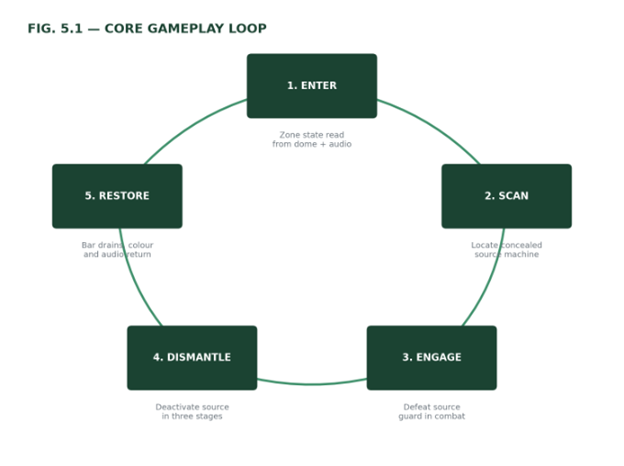
Fig. 5.1 — The five-stage regional loop.
|
Stage |
Player
activity |
|
1. Enter |
Regional pollution
state is read from dome colour, dome surface
density, and ambient audio |
|
2. Scan |
The concealed source
machine is located through spatial exploration |
|
3. Engage |
The source guard is
defeated in combat using the matched elemental form |
|
4. Dismantle |
The source machine
is deactivated across three discrete interaction stages |
|
5. Restore |
Regional pollution drains colour
and audio return; the next form is awarded |
5.2 Zone Pollution Bar
Each
region maintains an independent pollution value between 0 and 100. Regional
values are independent except where linked by the
displacement transport pathways specified in Chapter 4.
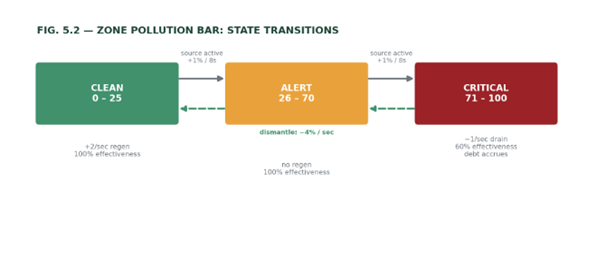
Fig. 5.2 — Pollution bar state transitions and
associated effects.
|
State |
Range |
Spirit
Energy |
Form
effectiveness |
Additional
effect |
|
Clean |
0–25 |
+2 per second |
100% |
Ambient restoration
continues |
|
Alert |
26–70 |
No regeneration |
100% |
Source active |
|
Critical |
71–100 |
−1 per second |
60% |
Corruption debt
accrues |
Bar
movement values
|
Event |
Change |
|
Active source
machine, per 8 seconds |
+1% |
|
Source guard
defeated |
Bar freezes |
|
Source machine
dismantled |
−4% per second until
0 |
|
Mismatched form
applied to source machine |
+15% (displacement,
see 5.5) |
|
Ejection |
+8% |
|
Incoming
displacement plume |
+5% |
Pacing
target: approximately six minutes from Alert threshold to Critical threshold at
standard accumulation rate, establishing a regional duration of 8–12 minutes
without recourse to a visible timer. The dismantle drain rate of −4% per second
is a rhetorical rather than a balancing value: the
drain constitutes the reward, and reducing it for
difficulty purposes would convert the payoff into a delay.
5.3 Spirit Energy
Spirit
Energy is a pool of 100 governing all ability use. It regenerates at +2 per
second within Clean regions only; no regeneration
occurs at Alert or Critical, preventing attritional recovery within hostile
regions.
|
Form |
Energy
cost |
Damage |
Secondary
effect |
|
Water |
12 |
20 |
Chains to adjacent
water-medium targets, +4 energy per chain |
|
Root |
15 |
25 |
Pins target for 3
seconds |
|
Soil |
10 per second channelled |
15 per second |
Effect radius
expands while held |
|
Wind |
14 |
18 |
Redirects airborne
matter rather than destroying it |
|
Sound |
8 |
12 |
Absorbs an incoming
sound attack and redirects it as a projectile |
Transformation
between forms costs 5 energy. This value is deliberately small but non-zero: it
prevents the player from cycling forms without cost in order
to identify the correct one by trial, requiring instead that the region
be read before commitment.
5.4 Form System and Unlock Chain
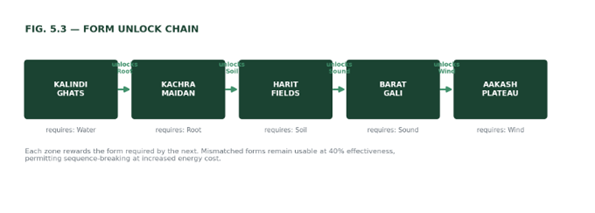
Fig. 5.3 Form unlock progression across five
regions.
Prithvi
begins with the Water form intact, corresponding to her awakening at the
Kalindi Ghats. Each region awards the form required by
the subsequent region rather than the form used to complete it, ensuring that
each reward is mechanically load-bearing at the point of delivery.
|
Order |
Region |
Source
machine |
Form
required |
Form
awarded |
|
1 |
Kalindi Ghats |
Industrial Discharge
Manifold |
Water (initial) |
Root |
|
2 |
Kachra
Maidan |
Plastic Waste
Compactor |
Root |
Soil |
|
3 |
Harit Fields |
Pesticide Chemical
Reservoir |
Soil |
Sound |
|
4 |
Barat Gali |
DJ Truck and Sparkbot array |
Sound |
Wind |
|
5 |
Aakash Plateau |
Smog Stack and AI
Server Network |
Wind |
— |
5.4a
Element Select Menu and XP-Gated Unlocks
In
addition to the sequential form unlock chain above, forms are also gated behind
an experience-point threshold, visualised through a
dedicated Element Select menu. Prithvi earns XP by visiting Prayer Point
figures (see 3.2): each interaction grants XP and increases her visible glow.
Locked forms appear as dimmed, textureless orbs with
a lock icon; once the XP threshold is met, the orb ignites into its elemental colour and becomes selectable.
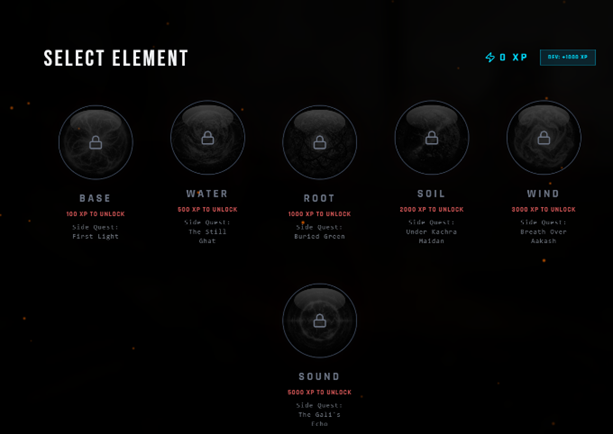
Fig. 5.3a — Element Select menu, showing
locked forms with XP thresholds.
|
Form |
XP
to unlock |
Side
quest |
Region
tie-in |
|
Base |
100 |
First Light |
Prithvi’s awakening |
|
Water |
500 |
The Still Ghat |
Kalindi Ghats |
|
Root |
1000 |
Buried Green |
Harit Fields |
|
Soil |
2000 |
Under Kachra Maidan |
Kachra
Maidan |
|
Wind |
3000 |
Breath Over Aakash |
Aakash Plateau |
|
Sound |
5000 |
The Gali’s Echo |
Barat Gali |
Each
side quest is a self-contained detour tied to its form’s home region, rewarding
completion with enough XP to guarantee that form’s unlock: First Light has
Prithvi restore power to a single dead prayer point; The Still Ghat has her
cleanse Kalindi Ghats’ stepped waterfront so pilgrims can reach the river
again; Buried Green has her coax dormant roots through a season of drought in
Harit Fields; Under Kachra Maidan sends her digging
past three landfill strata to soil that still remembers being fertile; Breath
Over Aakash has her cross the plateau’s airspace against a corrupted headwind; and
The Gali’s Echo has her silence a discordant sound trapped in Barat Gali’s
compressed lane before it reaches the shrine.
5.5 Mismatched Forms and Displacement
Applying
an incorrect elemental form does not produce a null result. A null result is
unreadable: players interpret an absence of effect as a defect rather than as
feedback.
|
Matched
form |
Mismatched
form |
|
|
Damage output |
100% |
40% |
|
Energy cost |
Base value |
×1.5 |
|
Dismantle drain rate |
−4% per second |
−1.5% per second |
|
Effect on source
machine |
Dismantles |
Displaces pollution |
The 40%
figure preserves the possibility of sequence-breaking while rendering it
economically unviable: a 140-health source guard requires approximately seven
matched applications, totalling 84 energy,
against approximately eighteen mismatched applications totalling
324 energy, measured against a pool of 100 with no
regeneration available at Alert state. The constraint is enforced by the
economy rather than by a lockout.
Displacement
Displacement
occurs only when a mismatched form is applied to a source machine. Mismatched
application to a source guard produces reduced damage only. This restriction is
deliberate: the displacement event is rhetorically significant and would lose
legibility if triggered on every imprecise attack.
- Origin
region pollution: +15%
- Receiving region
pollution: +5%
- Interface
readout: POLLUTION DISPLACED — NOT REMOVED
- A
visible plume travels in-world toward the receiving region
5.6 Hazards
Hazards are
environmental dangers without autonomous behaviour.
They are distinguished from enemies in that they cannot be defeated, only
avoided or neutralised.
|
Hazard |
Region |
Effect |
Neutralisation |
|
Discharge outflow |
Kalindi Ghats |
6 damage per second
on contact |
Water form disperses
temporarily |
|
Compaction crush
zone |
Kachra
Maidan |
25 damage on contact |
Timing-based
avoidance during idle cycle |
|
Pesticide spray
trail |
Harit Fields |
6 damage per second,
persistent |
Soil form neutralises permanently |
|
Firecracker
detonation |
Barat Gali |
Regional pollution
+3% per detonation |
Wind form disperses;
Sound form at reduced effect |
|
Smog layer |
Aakash Plateau |
Obscures navigation;
no direct damage |
Wind form clears
entire layers |
5.7 Corruption Debt
Prolonged
occupancy of a Critical region without progress degrades Prithvi's ability
charge. An earlier specification rendered this loss permanent; that model
imported roguelike logic into a linear structure and admitted unwinnable states.
The revised specification is recoverable.
|
Rule |
Value |
|
Accrual |
Every 30 seconds at
Critical without progress: active form loses 10 ability charge |
|
Floor |
Ability charge
cannot fall below 30; no unwinnable state is reachable |
|
Recovery |
A spirit resonance
point restores 25 charge, once per point per region |
|
Carry-over |
Departing a region
at Critical carries half the accrued debt into the next region |
Progress
is defined as damage dealt to a source guard or source
machine, or completion of a dismantle stage, within the preceding 30-second
window. Exploration and puzzle-solving do not accrue debt; the system penalises stalling rather than investigation.
5.8 Failure Architecture
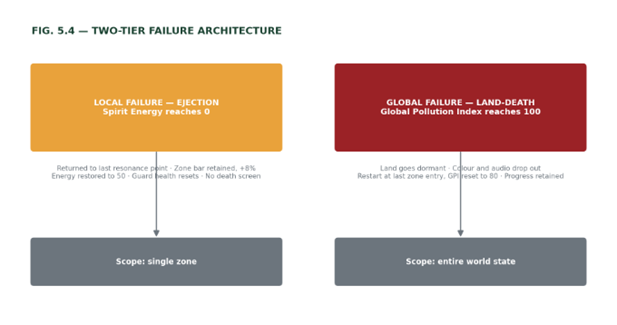
Fig. 5.4 — Two-tier failure architecture:
local and global.
Local
failure — Ejection
Prithvi
cannot die. She is a spirit rather than an organism, and a death state would be
inconsistent with the character. Exhaustion of Spirit Energy instead produces a
loss of cohesion.
|
Element |
State
on ejection |
|
Regional pollution
bar |
Retained, then
increased by 8% |
|
Source machine
damage |
Retained |
|
Source guard health |
Reset to full |
|
Spirit Energy |
Restored to 50 |
|
Corruption debt |
Retained |
|
Ability charge |
Unchanged |
Retention
of regional pollution and source machine damage renders ejection a reduction in
rate of progress rather than a loss of progress. Guard health resets to prevent
combat degenerating into attrition across repeated attempts. On the third ejection
within a single region, enemies enter a reinforced state: detection radius
increases by 50% and the source guard gains a second
attack pattern.
Conventional
death-and-respawn assumes a mortal protagonist inside a static world. Ejection
inverts both halves of that: Prithvi persists and the world degrades, so the
cost of failure lands on the environment rather than on the character. That
follows the same systemic-causation pillar set out in Chapter 1.
Global
failure - Land-death
The Global
Pollution Index (GPI) is the aggregate of all five regional pollution values.
It governs the terminal failure state.
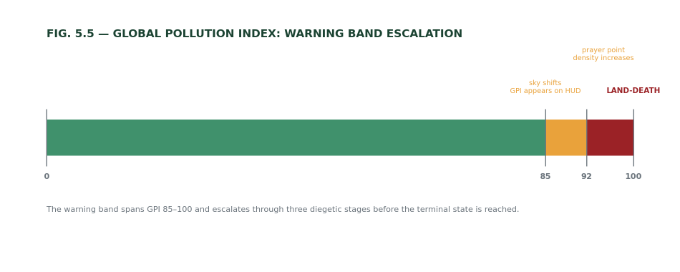
Fig. 5.5 — Global Pollution Index warning band
escalation.
|
GPI |
Event |
|
85 |
Warning band opens: sky tone shifts, low ambient tone enters the mix,
GPI readout appears on the interface for the first time |
|
92 |
Prayer point density
increases sharply across all regions, signposting the recovery route in
advance of need |
|
98 |
Screen margins
desaturate; Prithvi's glow pulses at half rate |
|
100 |
Land-death. Colour and audio drop out entirely; regional domes become
opaque and unresponsive. Prithvi persists, dimmed, with nothing remaining to
restore. |
Recovery
from land-death returns the player to the last region entry save with the GPI
reset to 80 rather than to zero. Elemental forms, unlocks, and narrative
progress are never lost. The cost is positional: the player is returned to the
margin of failure rather than to the beginning of the game.
A game with
no loss condition at all would be arguing, whether it meant to or not, that
environmental recovery is inevitable, and that isn't a position this project
wants to take. The land-death state is meant to sit between Alba: A Wildlife
Adventure, which admits no failure, and Endling: Extinction is Forever, where
decline can't be reversed. Both recovery and failure need to stay possible for
the claim about environmental agency to hold.
5.9 Collectables and Power-Ups
|
Element |
Function |
Persistence |
|
Spirit resonance
point |
Restores 25 ability
charge; establishes ejection return location |
One activation per
point per region |
|
Prayer point |
Restores global
state sufficient to recover approximately one region's capacity |
Fixed placement;
density scales with GPI |
|
Elemental form |
Permanent ability unlock awarded on regional restoration |
Permanent |
6
Chapter 6: Gameplay and User Interface
6.1 Sequence of Play
The
Unclean is structured as five regions traversed in a directed sequence, framed by
three narrative acts. There are no discrete levels within a region; each region
is a continuous space containing one source machine, one source guard, a
variable number of hazards, and between two and four spirit resonance points.
|
Act |
Regions |
Duration
(est.) |
Function |
|
Act 1 Awakening |
Kalindi Ghats |
10–14 minutes |
Tutorial region;
introduces the loop, the bar, and the Water form |
|
Act 2 Resistance |
Kachra
Maidan, Harit Fields, Barat Gali |
35–45 minutes |
Systems deepen; displacement
consequences become apparent; GPI becomes relevant |
|
Act 3 Reckoning |
Aakash Plateau |
12–18 minutes |
Non-combat
resolution; cascade restoration |
6.2 Camera
The
camera is third-person and camera-relative, with
Prithvi centred in frame. Over-the-shoulder framing
is not employed, as the protagonist possesses neither shoulders nor a fixed
facing direction. Camera distance and height are authored per region rather
than set globally, as camera framing performs spatial design work in addition
to its functional role.
|
Region |
Distance |
Height |
Rationale |
|
Kalindi Ghats |
400cm |
180cm |
Baseline framing;
establishes camera behaviour before complication |
|
Kachra
Maidan |
350cm |
220cm |
Elevated angle
compensates for obstructed sightlines in debris fields |
|
Harit Fields |
550cm |
280cm |
Extended distance
supports the region's long detection radii |
|
Barat Gali |
280cm |
150cm |
Compression is the
design intent; sky is withheld until the third-phase release |
|
Aakash Plateau |
450cm |
200cm |
Extended vertical
pitch range prioritised over horizontal distance |
Barat
Gali requires spring-arm collision handling at the specified distance. The
resulting further compression during combat within the lane is consistent with
the intended experience and is not treated as a defect.
6.3 Controls
|
Action |
Keyboard
and mouse |
Gamepad |
|
Movement |
W A S D |
Left stick |
|
Camera |
Mouse |
Right stick |
|
Primary ability |
Left mouse button |
Right trigger |
|
Channelled ability (hold) |
Left mouse button,
held |
Right trigger, held |
|
Cycle form forward |
Mouse wheel up / E |
Right bumper |
|
Cycle form backward |
Mouse wheel down / Q |
Left bumper |
|
Form selection wheel |
Tab, held |
Left trigger, held |
|
Interact (resonance
/ prayer point) |
F |
A / Cross |
|
Scan |
Right mouse button |
Left stick click |
|
Pause menu |
Escape |
Start / Options |
6.4 Heads-Up Display
The
interface follows a strict division: the world carries regional state, and the heads-up
display carries the protagonist's state. No element is duplicated between the
two layers.
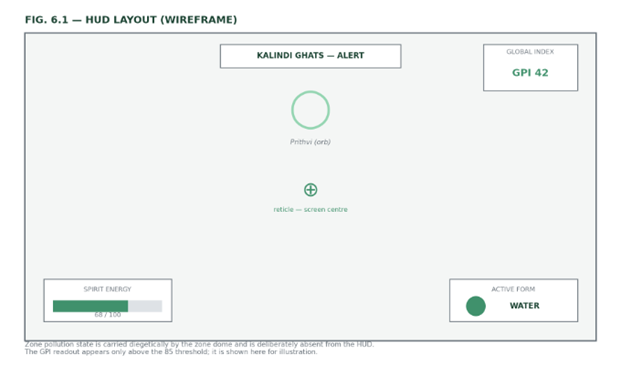
Fig. 6.1 Heads-up display layout, wireframe.
|
Layer |
Communicates |
Carried
by |
|
World (diegetic) |
Regional pollution
state |
Dome colour, dome surface pattern density, ambient audio |
|
Heads-up display |
Prithvi's condition |
Spirit Energy,
active form, global index, corruption debt, GPI warning |
|
Element |
Displays |
Behaviour |
|
Spirit Energy
readout |
Current energy,
0–100 |
Persistent, lower left.
Precise complement to the glow read. |
|
Active form
indicator |
Form
icon and colour |
Persistent, lower
right. Colours the reticle on a match. |
|
Region label |
Region name and
severity word |
Appears on approach
to a regional boundary; not persistent |
|
Global index readout |
Aggregate GPI value |
Appears only above
GPI 85 |
6.5 Targeting and Feedback
Targeting
employs a screen centre reticle rather than automatic
target acquisition. The reticle provides the sole interface surface on which the
form-matching relationship
the game's central puzzle is communicated before the player
commits energy to an action.
|
Reticle
state |
Appearance |
Meaning |
|
Neutral |
Thin outline, low
opacity |
No valid target |
|
Match |
Fills with active
form colour and tightens |
Active form counters
this target |
|
Mismatch |
Fills grey and
pulses outward |
Active form is
incorrect; 40% damage will result |
|
Source lock |
Diamond replaces
circle |
Target is a source
machine; mismatch will trigger displacement |
6.6 Menus and Screens
Title
screen — a dynamic reflection of world state
The
title screen is not a fixed image. It is rendered from the same global-state
system that governs Prithvi's glow in play, so the very first thing a player
sees is a readout of how the world currently stands. Three reference states
anchor the design; the screen interpolates continuously between them rather
than switching abruptly at fixed thresholds.
|
Global
state |
Environment |
Prithvi's
orb |
Interface
tone |
|
0% fully corrupted |
Industrial vista:
stacks, scaffolding, an active discharge pipe running into a pooling waste
puddle. Near-black, dusk-toned, heavy atmosphere. |
Small and dim,
consistent with the low glow-radius rule specified in Chapter 5 |
Menu buttons
rendered in amber (Start) and red (Exit), echoing regional Alert/Critical
severity colours |
|
50% partially restored |
The same vista with
visible but incomplete recovery: reduced smoke density, the discharge pipe
reduced to an intermittent trickle, first hints of colour
returning to the ground |
Mid-sized, brighter,
warm white beginning to assert itself over any residual form ``colour tint |
Interface tone
transitional between corrupted and restored treatments |
|
100% fully restored |
Lush and green, the
industrial structures still present but reclaimed by vegetation, full
daylight |
Full size, full
brightness, steady warm white |
Interface rendered
in the restored regional palette |
Because
this screen is generated from live global state rather than authored as a fixed
asset, it also functions as a passive summary of the player's save file:
returning to the title screen after a session communicates, before any menu is
read, how much of the world remains to be restored. This extends the
diegetic-interface commitment established in Chapter 6.4 to the one screen that
exists outside of gameplay.
|
0% global state |
50% global state |
100% global state |



Fig. 6.2 Title screen prototype builds across
the corruption-to-restoration gradient.
The base
glow colour and the discharge-pipe animation at 0%
still need checking against the form-colour system in
Chapter 7.3, where cyan is reserved specifically for the Water form. If the
resting-state glow is meant to read as neutral rather than as an active Water
indicator, the title screen's orb colour should be
brought in line with that rule.
|
Screen |
Contents |
|
Title screen |
Dynamic three-state
vista as above, generated from global pollution state. Options: Start, Load
Game, Settings, Exit. |
|
Pause menu |
Region status summary,
form reference, settings access, quit to title |
|
Settings — Display |
Resolution, quality
preset, brightness, screen margin desaturation toggle, high contrast UI,
camera shake toggle |
|
Settings Audio |
Master volume
slider, effects, ambient, music; ambient-cue emphasis toggle; subtitles and
closed captions toggle |
|
Settings
Accessibility |
Text scale,
pollution accumulation rate, ability energy cost, colourblind pattern emphasis, toggle-to-sprint/aim,
auto-complete QTE toggle |
|
Settings Controls |
Full remapping, invert axes, sensitivity |
The
settings list is housed within a dedicated scrolling panel, allowing further
options to be added without the menu growing unbounded.
6.7 Cutscenes
Cutscenes
are minimal and in-engine. There is no pre-rendered
footage and no dialogue. Three sequences are specified: the
Act One awakening at the Kalindi Ghats; the Act
Three approach to the AI network core; and the cascade restoration on
completion. Each is a controlled camera move within the playable environment rather
than a separate cinematic asset, preserving continuity with the game's diegetic
interface commitments.
6.7a Loading Screens
Loading
screens displayed during region transitions carry factual and tip content
unrelated to the game's own fiction, distinct in function from every other
interface element specified in this chapter. Where the rest of the interface
communicates the state of this game's world, the loading screen deliberately steps
outside it to communicate the state of the real one. This is a secondary
channel for the project's central argument, extending the procedural rhetoric
established through mechanics into the game's idle moments rather than
confining it to play.
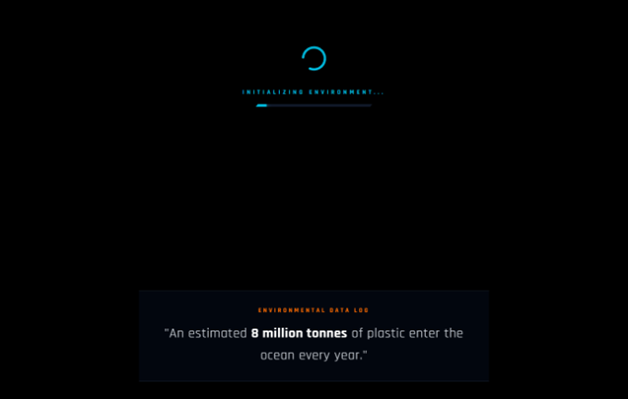
Fig. 6.3 — Loading screen prototype build,
Unreal Engine 5.
Content
structure
|
Element |
Rule |
|
Trigger |
Displayed during
region-load transitions only. Not shown on ejection, which is instantaneous
and carries no load. |
|
Pairing |
One fact paired with
one tip per screen, visually distinguished by typographic treatment so the
two categories remain legible as different kinds of claim |
|
Region relevance |
Content is global in
scope and deliberately not tied to the loading region, per design decision |
|
Rotation |
Drawn from a shared
pool, non-repeating within a session where the pool size allows |
|
Sourcing |
Every fact carries a
citation line naming the source organisation and
year |
Fact
and tip framing
Facts are
drawn from global health and environmental data and are stated without
reference to the game's fiction. Tips are restricted to documented instances of
collective or civic action rather than individual consumer behaviour,
consistent with the systemic-causation design pillar established in Chapter 1:
the project does not want to argue, even in a loading
screen, that individual product choices resolve problems it otherwise frames as
systemic.
|
# |
Fact |
Source |
|
1 |
Ambient and household
air pollution combined are linked to an estimated 7 million premature deaths
worldwide each year. |
World Health
Organization |
|
2 |
An estimated 99% of
the world's population breathes air that exceeds WHO air quality guideline
limits. |
World Health
Organization, 2022 update |
|
3 |
Around 1.7 billion
people use a drinking water source contaminated with faecal
matter. |
World Health
Organization |
|
4 |
Approximately
829,000 people die annually from diarrhoeal disease
attributable to unsafe drinking water, sanitation, and hygiene. |
World Health
Organization |
|
# |
Tip |
Real-world
basis |
|
1 |
In Flint, Michigan,
it was volunteer citizen water-testing, organised
with a university engineering team, that produced the evidence exposing the
city's lead contamination crisis, not the official monitoring system. |
Flint water crisis,
documented public record |
|
2 |
London's Great Smog
of 1952 killed thousands within days and led directly to the UK's Clean Air Act
of 1956, regulation that followed sustained public pressure rather than
individual behaviour change. |
UK Clean Air Act
1956, documented public record |
Verification
status: the four WHO figures above are commonly cited and believed accurate in
order of magnitude, but were compiled from general
knowledge without live access to who.int and must be checked against the
current WHO data before submission, both for figure accuracy and for the
specific year of publication. Both tips are drawn from well-documented
historical record and are lower-risk,
but should still be independently confirmed. This pool is intentionally
small; expanding it for the final build should follow the same sourcing
standard rather than relaxing it for volume.
6.8 Accessibility
|
Requirement |
Provision |
|
Colour
vision deficiency |
Regional severity is
carried by dome surface pattern density and by text label independently of
hue; high contrast UI toggle for interface elements generally |
|
Text legibility |
Scalable text size
for region labels and interface numerals; subtitles and closed captions for
all spoken or textual cues |
|
Difficulty
accommodation |
Adjustable pollution
accumulation rate and ability energy cost |
|
Photosensitivity |
Firecracker
detonation intensity reduction toggle for Barat Gali Phase 2; independent
camera shake toggle |
|
Motor accessibility |
Full control
remapping; hold-to-channel abilities offer a toggle alternative;
toggle-to-sprint/aim in place of hold; auto-complete for time-sensitive
prompts |
|
Hearing
accessibility |
Subtitles and closed
captions toggle, covering ambient cue callouts and interface tones |
Two
accessibility provisions currently outpace the underlying system specification.
"Toggle-to-sprint/aim" presumes sprint and aim as distinct player
actions, and "auto-complete QTE" presumes a quick-time-event
mechanic; neither appears in the control scheme (6.3) or
the mechanics specification (Chapter 5) as currently written. These options
should either be matched to a specified mechanic or removed once the relevant
systems are confirmed, so that the accessibility menu does not promise
functionality the game does not contain.
7
Chapter 7: Visual Experience
7.1 Ge-stalt
The
intended overall impression is one of quiet ruin rather than spectacle. The
player is not presented with an apocalypse; they are presented with
infrastructure that has continued to function correctly for longer than anyone remained
to supervise it. The emotional register is closer to melancholy than to dread,
and the restoration of a region is intended to produce relief rather than
triumph.
The
player's first encounter with this relationship occurs before gameplay begins.
The title screen itself is rendered from live global-state data rather than as
a fixed image, ranging from a dim orb over a corrupted industrial vista through
to a full, bright, restored landscape (specified in Chapter 6.6). This establishes
the relationship the entire visual system depends upon:
what the player can see is a function of the protagonist's condition, and that
relationship is legible from the very first frame.
7.2 Corrupted and Restored States
|
Property |
Corrupted
state |
Restored
state |
|
Lighting |
Near-black terrain
under dusk-toned skies; detail carried by VFX and by Prithvi's glow |
Full daylight;
ambient illumination independent of the protagonist |
|
Colour |
Desaturated with
residual industrial hues
sodium orange, chemical green |
Full saturation;
blue watercourses, gold agricultural terrain, open sky |
|
Atmosphere |
Dense particulate,
low visibility, heavy volumetrics |
Clear air; visible
distance and horizon |
|
Vegetation |
Absent, dead, or
industrially deformed |
Present and
responsive to the protagonist's proximity |
The
corrupted state is dark rather than desaturated. An earlier draft specified a
desaturated grey-brown treatment; the implemented approach uses low-key lighting
instead, and this document reflects the implemented approach. The decision is load-bearing: because Prithvi's glow radius is the principal
light source within corrupted regions, and because that radius contracts as
global state deteriorates, a player who has neglected
multiple regions experiences reduced visibility as a direct mechanical
consequence. The visual treatment and the systemic consequence are the same
object rather than two systems in agreement.
7.3 Colour, Shape
and Light
|
Element |
Treatment |
Function |
|
Prithvi's glow |
Warm white; radius
driven by global state, intensity by Spirit Energy |
Primary light source
and primary state indicator |
|
Elemental form colours |
Water: cyan. Root: deep green. Soil: ochre. Wind: pale grey.
Sound: violet. |
Form
identification; reticle match colour |
|
Regional domes |
Green, amber, red by
severity; surface pattern density scales with severity |
Diegetic regional
state, colourblind-independent |
|
Industrial machinery |
Hard-edged, orthogonal,
high-contrast against organic terrain |
Silhouette
distinction between antagonist and environment |
|
Restoration
transition |
Saturation and
illumination sweep outward from the dismantled source |
The primary
emotional reward of the loop |

Moodboard — corrupted and restored palettes. (Concept
art generated with Google AI Studio.)
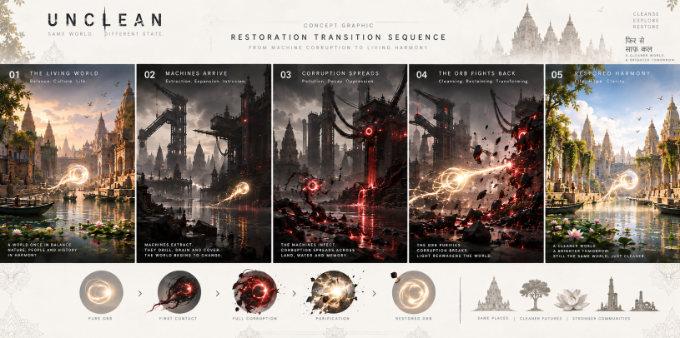
Concept graphic — restoration transition
sequence, from machine corruption to living harmony. (Concept art generated
with Google AI Studio.)
7.4 Camera Handling
Camera
movement is smooth and unhurried throughout, with two exceptions. On ejection,
the camera pulls back and desaturates over approximately three seconds, marking
the loss of cohesion without recourse to a failure screen. On the third-phase
release within Barat Gali, the camera rises as the lane opens, and the sky
becomes visible for the first time in that region. The second of these is the
single most important camera event in the game and the authored framing throughout
the preceding two phases exists to make it possible.
8
Chapter 8: Audio Experience
8.1 Soundscape Vision
Audio
carries the regional pollution state with equal weight to the visual dome
system, and in several regions carries it earlier —
the player hears a region's condition before they can see it clearly. Corrupted
regions are dense with mechanical noise: compressor cycles, hydraulic
actuation, low-frequency industrial drone. As a region restores, the industrial
layer is removed before the natural layer is introduced, producing a deliberate
interval of near-silence that constitutes the
emotional centre of the loop.
Moser
(2010) argues that emotional engagement drives behavioural
change more effectively than information alone. The audio design is constructed
to carry the game's affective argument, which is also why the pollution system
is not communicated through an alarm or a countdown.
8.2 Essential Sound List
|
Category |
Required
assets |
|
Ambient corrupted |
Industrial drone bed
per region; compressor cycle; hydraulic actuation; distant machinery;
particulate wind |
|
Ambient restored |
Flowing water;
birdsong (regionally appropriate species); wind through vegetation; distant
human activity |
|
Prithvi |
Transformation
stinger per form (×5); glow hum, variable by energy; cohesion loss on
ejection |
|
Abilities |
Water surge and
chain; root emergence; soil channel (looping); wind blast; sound absorption
and redirection |
|
Enemies |
Per-unit alert stinger;
attack tell per unit (×5); source machine stage-completion report |
|
Interface |
Reticle match and
mismatch tones; displacement warning; resonance and prayer point activation |
|
Systemic |
GPI threshold tones
at 85, 92, 98; restoration sweep; cascade restoration finale |
8.3 Audio as Gameplay Information
|
Cue |
Information
conveyed |
|
Ambient density |
Regional pollution
state, audible before visual confirmation |
|
Directional
machinery loop |
Bearing to the
concealed source machine during the Scan stage |
|
Attack tell |
Incoming enemy
attack, timed to the tell windows specified in Chapter 5 |
|
Reticle tone |
Form
match or mismatch, redundant with the visual reticle state |
|
Glow hum pitch |
Spirit Energy level
without reference to the interface readout |
8.4 Music
Music is
sparse and largely absent during regional play, entering only at restoration
and at act transitions. The intended instrumentation draws on North Indian
classical traditions — bansuri, sarangi, tanpura drone — without pastiche, and is treated as an extension of the restored
ambient layer rather than as an accompanying score. Barat Gali is the sole
exception: its first phase is dominated by diegetic amplified music from the DJ
truck, which functions simultaneously as the region's antagonist and its
soundtrack.
Reference
works
- Journey
(thatgamecompany, 2012) —
restraint in scoring; music as reward rather than accompaniment
- Kena:
Bridge of Spirits (Ember Lab, 2021) — culturally
specific instrumentation integrated with a spirit-restoration mechanic
- Abzû
(Giant Squid, 2016) — audio as the primary carrier of environmental
restoration
9
Chapter 9: Level Design
Detailed
level documentation is delivered as a separate artefact. This chapter provides
the beat chart summary and the spatial design rationale for each region.
9.1 Beat Chart
|
Beat |
Region |
Objective |
Story
beat |
Dominant
mechanic |
Form |
Experience |
|
1 |
Kalindi Ghats |
Dismantle the
Discharge Manifold |
Prithvi wakes
diminished; the river is black |
Combat introduction;
bar reading |
Water |
Stagnation;
compressed descent |
|
2 |
Kachra
Maidan |
Dismantle the
Compactor Unit |
The scale of
accumulation becomes apparent |
Spatial navigation;
obstructed sightlines |
Root |
Disorientation |
|
3 |
Harit Fields |
Dismantle the
Chemical Reservoir |
Poisoned
agriculture; the land cannot feed |
Exposure; long
detection radii |
Soil |
Being seen first |
|
4a |
Barat Gali |
Silence the speaker
stacks |
Celebration
continuing over ruin |
Sound absorption and
redirection |
Sound |
Compression; noise |
|
4b |
Barat Gali |
Clear the Sparkbot array |
The air becomes
unbreathable |
Chain detonation
management |
Sound |
Escalation; scarcity
of tools |
|
4c |
Barat Gali |
Sweep the residue |
The street falls
silent |
Channelled restoration; no fail state |
Soil |
Release; sky
revealed |
|
5 |
Aakash Plateau |
Reach and redirect
the AI network |
The origin is not
malicious, only efficient |
Vertical traversal;
objective substitution |
Wind |
Elevation;
resolution without violence |
9.1a Zone Missions
Each region
carries two missions built on the same premise: a machine is taking or emitting
far more than the world actually needs, and Prithvi
resolves it not by destroying the machine but by applying the natural elemental
force she has gained in that region against it. This keeps every mission
legible as “nature correcting excess” rather than generic combat, and ties
directly to the form unlock chain in 5.4.
9.1b Elemental Environmental Hazards
Each region
also carries an ambient environmental hazard generated by its dominant form of
pollution, independent of the mission machines above. Only the form native to
that hazard resists it; every other form takes a steady corruption-meter drain
while active there. This means the player cannot simply keep one favourite form equipped everywhere — a Water form entering Barat Gali's noise-saturated streets is
overwhelmed by decibel pressure just as a Sound form would struggle against Kalindi
Ghats' current. The mismatch is deliberate: it forces a form swap before a
region's missions can be attempted comfortably, reinforcing that each element
is a specific answer to a specific kind of harm (Section 2, procedural
rhetoric), not a universal tool.
9.2 Spatial Design Rationale
Totten
(2014) establishes that spatial compression, threshold
placement, and the prospect-refuge relationship direct player emotion
structurally. Each region in The Unclean derives its encounter design from the
affordances of its architectural typology rather than applying a uniform combat
template across varied set dressing.
|
Region |
Compression |
Prospect
/ refuge |
Threshold
treatment |
|
Kalindi Ghats |
High laterally,
descending vertically |
Refuge scarce; the
steps offer no cover |
Water's edge
functions as the point of no retreat |
|
Kachra
Maidan |
Variable; debris
creates irregular pockets |
Refuge abundant,
prospect near-absent |
Sightline breaks function
as de facto thresholds |
|
Harit Fields |
Minimal |
Prospect total,
refuge absent |
Field boundaries and
irrigation channels |
|
Barat Gali |
Maximum; the lane
admits no lateral movement |
Neither available
until the third phase |
The lane's opening
is the game's principal threshold |
|
Aakash Plateau |
Vertical rather than
lateral |
Prospect conditional
on smog clearance |
Each cleared smog
layer constitutes a threshold |
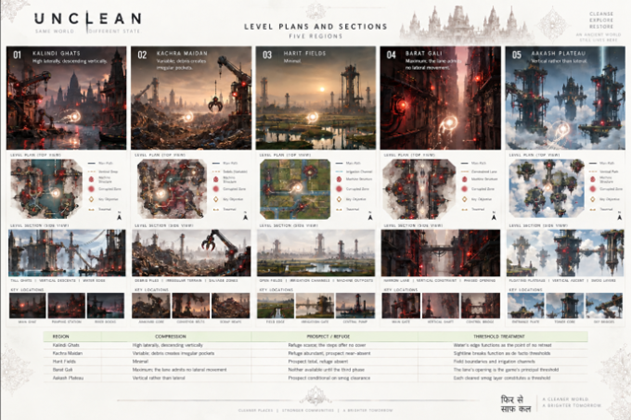
Level plans and sections — five regions. (Concept
art generated with Google AI Studio.)
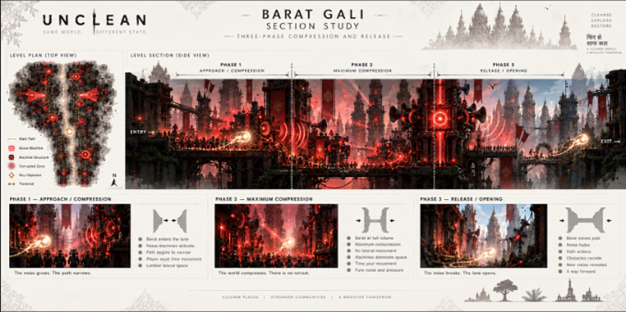
Barat Gali — section study showing three-phase
compression and release. (Concept art generated with Google AI Studio.)
Chapter 9a: Systems Design and Implementation
9a.1 Engine and Scripting Architecture
The
prototype is built in Unreal Engine 5 using a modular Blueprint (BP)
architecture, chosen over custom C++ systems to keep scope manageable within
the project timeline. Nanite geometry handling and Lumen global illumination are
used specifically because the corrupted-to-restored lighting transition
(Chapter 7) is far more convincing under dynamic global illumination than under
static, baked lighting.
9a.2 Pollution Bar, Elemental Swap and Ambient
Hazard Logic
Combat,
the elemental-form swap, and the pollution/corruption meter (5.5, 9.1b) are
scripted in the Player Blueprint using Unreal's
Gameplay Ability System (GAS), which provides ability-cooldown and status-effect
handling out of the box rather than requiring bespoke systems. Each elemental
form is implemented as a Gameplay Ability set gated by an XP-threshold check
(5.4a); equipping a form swaps the active ability set and the character's
ability-tag, which the ambient-hazard volumes placed per region (9.1b) read
against to decide whether to apply their steady meter-drain. Region hazard
volumes are simple trigger volumes carrying a hazard-tag (current, fumes,
pesticide drift, decibel pressure, smog) checked against the player's active
form tag every tick while inside the volume.
9a.3 Enemy AI (Source Machines)
Source-machine
antagonists (5.4, 9.1a) use Behaviour Trees with
patrol, alert and attack states; each machine's "excess" state
(running above its stated quota) is a Blackboard value the mission logic checks
to confirm the counter-mechanic has brought it back to legal output before
marking the mission resolved.
9a.4 Asset Pipeline
Quixel Megascans (royalty-free
within UE5) supplies base natural-environment assets for each region; Blender
is used for custom mechanical source-machine models; Adobe Substance Painter,
via the Kingston University Adobe licence, handles
texturing of those custom assets. Concept art exploring Prithvi's elemental
forms and regional/NPC designs was generated with Google AI Studio and used as
an art-direction reference for the in-engine models, not as final in-game
assets.
10
Chapter 10: Monetisation
and Bonus Material
10.1 Monetisation
Model
The
Unclean is designed as a single premium purchase with no in-game store, no
proxy currency, no microtransactions, and no loot boxes. This is a design
decision rather than solely an ethical one: the reward framework specified in
Chapter 2 places the emotional payoff in the restoration transition itself, and
any mechanism permitting that outcome to be purchased would dismantle the
argument the game is constructed to make.
|
Model
element |
Position |
|
Base product |
Single premium purchase,
PC digital distribution |
|
In-game store |
None |
|
Proxy currency |
None |
|
Loot boxes or randomised purchase |
Prayer points |
|
Cosmetic purchase |
None; Prithvi's
appearance is a state readout and cannot be decoupled from play |
|
Post-launch content |
If pursued,
delivered as a paid expansion adding regions rather than as fragmentary
purchasable content |
10.2 Achievements
Achievements
are delivered through the host platform's system. They are weighted toward precision
rather than completion, reinforcing the matched-intervention pillar.
|
Achievement |
Condition |
|
Matched |
Restore any region
without a single displacement event |
|
Undisplaced |
Complete the game
with zero displacement events recorded |
|
Cohesion |
Restore any region
without an ejection |
|
Below the Band |
Complete the game
without the GPI exceeding 85 |
|
Heard |
Interact with every
prayer point figure in a single playthrough |
|
Resonant |
Activate every
spirit resonance point across all five regions |
|
The Clean Cascade |
Complete the final
restoration with all five regions at pollution 0 |
|
Sequence Broken |
Restore a region
using a mismatched form throughout |
10.3 Replay Incentives and Bonus Material
|
Element |
Description |
|
Cascade quality |
The final
restoration renders visibly faster and more completely when regions have been
maintained; this is not stated to the player and constitutes the principal
replay incentive |
|
Sequence-breaking |
The 40% mismatched-form allowance permits deliberate out-of-order
completion as a self-imposed challenge |
|
Region gallery |
Unlocked on
completion; permits revisiting any region in its restored state without
enemies |
|
Design commentary |
Unlockable
annotations describing the architectural source of each region's spatial
structure |
Copyright, Credits and References
Academic sources
Bogost,
I. (2007) Persuasive Games: The Expressive Power of Videogames. Cambridge, MA:
MIT Press.
Crawford,
K. (2021) Atlas of AI: Power, Politics, and the Planetary Costs of Artificial
Intelligence. New Haven: Yale University Press.
Moser,
S.C. (2010) 'Communicating climate change: history, challenges, process and
future directions', WIREs Climate Change, 1(1), pp. 31–53.
Totten,
C.W. (2014) An Architectural Approach to Level Design. Boca Raton: CRC Press.
Ludography
Ember
Lab (2021) Kena: Bridge of Spirits [Game]. PC/PlayStation: Ember Lab.
Giant
Squid (2016) Abzû [Game]. PC/Consoles: 505 Games.
Herobeat Studios (2022) Endling: Extinction is
Forever [Game]. PC/Consoles: HandyGames.
Strange
Loop Games (2018) Eco [Game]. PC: Strange Loop Games.
thatgamecompany (2012) Journey [Game].
PlayStation 3: Sony Computer Entertainment.
ustwo games (2020) Alba: A Wildlife Adventure
[Game]. PC/Consoles: ustwo games.
Technical documentation
Epic
Games (2026) Unreal Engine 5 Documentation. Available at:
https://dev.epicgames.com/documentation/ (Accessed: 24 August 2026).
Third-party assets and attribution
|
Asset
/ Resource |
Type |
Purpose
in Unclean |
Source |
Date
Accessed |
|
Quixel
Megascans / Megaplants |
Environment assets |
Natural
environments, vegetation, rocks, surfaces and world dressing |
Fab — Unreal Engine
/ Quixel assets
(https://www.fab.com/channels/unreal-engine) |
06 Sep 2026 |
|
Unreal Engine
Samples |
Reference / sample
assets |
Level design,
environment and Unreal Engine workflow reference |
Epic Games — Samples
& Tutorials
(https://dev.epicgames.com/documentation/unreal-engine/samples-and-tutorials-for-unreal-engine) |
06 Sep 2026 |
|
Niagara VFX |
VFX / particle
system |
Orb particles,
cleansing effects, corruption effects, smoke and environmental VFX |
Epic Games — Niagara
Tutorials
(https://dev.epicgames.com/documentation/en-us/unreal-engine/tutorials-for-niagara-effects-in-unreal-engine) |
06 Sep 2026 |
|
Unreal Engine
Materials Tutorials |
Tutorials |
Material creation,
corruption/restoration materials and environmental surfaces |
Epic Games —
Materials Tutorials (https://dev.epicgames.com/documentation/unreal-engine/unreal-engine-materials-tutorials) |
06 Sep 2026 |
|
Niagara Quick Start |
Tutorial |
Development
reference for particle-based effects and Niagara systems |
Epic Games — Niagara
Quick Start
(https://dev.epicgames.com/documentation/unreal-engine/quick-start-for-niagara-effects-in-unreal-engine) |
06 Sep 2026 |
|
Mixkit
Sound Effects |
Audio library |
Environmental
ambience, impacts, whooshes, machinery and restoration sounds |
Mixkit
— Free Sound Effects (https://mixkit.co/free-sound-effects/) |
06 Sep 2026 |
|
Mixkit
License |
Licensing reference |
Verification of
permitted use for downloaded audio assets |
Mixkit
— License (https://mixkit.co/license/) |
06 Sep 2026 |
Copyright notice
This
document is produced for non-profit educational assessment.
Where copyrighted material is reproduced for illustrative purposes, such
reproduction is undertaken under fair dealing provisions for the purposes of
criticism, review and quotation. All third-party material, visual or otherwise,
is credited in the asset log above regardless of licensing status. Should this
document be published as part of a portfolio or development log, a full
copyright review will be required prior to release.
The Unclean Game Design
Document v2.0 · CI7800 Independent Project · Kingston University